

Austin Texas Landmarks: What Visitors Miss and How to Plan

Austin Texas landmarks revolve around the Texas State Capitol, the Congress Avenue Bridge bat colony, Mount Bonnell, Zilker Park with Barton Springs Pool, and the Sixth Street historic district. Most sit within a few miles of downtown, yet each needs different timing: the Capitol suits mornings, the bats suit dusk, and the overlooks suit early starts.
Key Takeaways
The Texas State Capitol dates to 1888 and stands 302 feet tall, 14 feet taller than the U.S. Capitol; expert-led and self-guided tours run seven days a week, though you should confirm the schedule with official Capitol channels.
A colony of 1.5 million Mexican free-tailed bats emerges from the Congress Avenue Bridge at dusk from spring through fall, but a sighting is never guaranteed on any given night.
The downtown corridor along Congress Avenue is walkable; Mount Bonnell, Zilker Park, and the LBJ Library need a car, rideshare, bike, or scooter.
Austin has 180 sites on the National Register of Historic Places, so a focused shortlist beats trying to see everything.
Cortado Villa in East Austin sleeps up to 12 guests in 4 bedrooms and 3.5 bathrooms, with Franklin Barbecue 0.3 miles away and the University of Texas campus 1 mile away.
Austin drew 23.7 million visitors and $10.2 billion in visitor spending in fiscal 2023-24, according to a City of Austin document that cites Travel Texas, the Texas Workforce Commission, and the U.S. Bureau of Labor Statistics. Those visitors share a short list of famous sights, which is why timing matters more than a longer checklist in 2026.
Alicia and Ben run Cortado Villa in East Austin, and guests ask practical questions before any history questions: how hot will it be, and where do we park? They also want to know what they can reach without a car. This guide answers those first, then covers the history behind each stop.
You will find the ten attractions most people search for, a table of ten historic landmarks with dates, honest notes on bats, heat, and stairs, and tour-booking guidance. For food, music, and nightlife beyond the landmarks, see our guide to things to do in Austin.
What Are the Top 10 Attractions in Austin, Texas?
The top attractions in Austin, Texas mix civic history with outdoor landmarks: the Texas State Capitol, the Congress Avenue Bridge bats, Zilker Park, Barton Springs Pool, Mount Bonnell, the Butler Trail, Sixth Street, the Driskill Hotel, the LBJ Library, and the French Legation. Each comes with one practical detail most guides leave out.
Texas State Capitol. The red granite building anchors the north end of Congress Avenue. Go in the morning, before the day heats up.
Congress Avenue Bridge bats. A seasonal dusk flight over Lady Bird Lake, covered in detail below.
Zilker Park. At 351 acres, it is open daily with free entry, though parking may cost money depending on the day.
Barton Springs Pool. A spring-fed pool inside Zilker Metropolitan Park. Check current hours and admission before you go.
Mount Bonnell. A limestone viewpoint with 102 steps and the best skyline-and-river view on this list.
Ann and Roy Butler Hike and Bike Trail. The 10-mile trail loop connects the bat bridge, Zilker Park, and the Long Center.
Sixth Street Historic District. Six blocks of Victorian-era commercial buildings from the late 1800s. Walk it by day for the architecture. If your group wants a quieter drink at night, Rainey Street, 1.5 miles from Cortado Villa, is the better call.
Driskill Hotel. Opened in 1886 at Sixth and Brazos Streets. The corner view alone justifies a stop.
LBJ Library and Museum. A 10-story tower on 30 acres of the University of Texas campus, with exhibits from the 1960s and 1970s.
French Legation State Historic Site. The oldest standing wood-frame structure in Austin and the smallest, quietest stop on the list.
What Is the Texas State Capitol Famous For?
The Texas State Capitol is the seat of Texas government, an 1888 granite building that stands 302 feet tall, 14 feet taller than the U.S. Capitol. It is famous for its Sunset Red Texas granite, quarried near Marble Falls, and for a cast-iron dome topped by the Goddess of Liberty.
Visiting is straightforward. Expert-led and self-guided tours run seven days a week. Tour schedules, closures, and entry rules change, so confirm them through official Capitol channels before you build a morning around it. Budget 60-90 minutes for a tour plus the grounds.
The Texas Governor's Mansion sits nearby. It dates to 1856, follows Greek Revival style, and has housed every Texas governor since Sam Houston. Check access separately, because a working residence does not follow a tourist schedule.
Congress Avenue ties the area together. It runs one mile from the Colorado River straight to the Capitol steps and was laid out in 1839 by Mirabeau Lamar, the second president of the Republic of Texas. Along it you will pass the Paramount Theatre (1915), still an active concert hall, and the Scarbrough Building (1910), Austin's first skyscraper. The Littlefield Building (1910), with its ornate terracotta facade, now houses the Austin Visitor Center; its architectural profile is worth reading beforehand.
What Are 10 Famous Historic Landmarks in Austin?
Austin's best-known historic landmarks date from the 1830s to the early 1900s and include the Capitol, the Governor's Mansion, and Congress Avenue. The city has 180 sites on the National Register of Historic Places, so the table below narrows the field to ten stops with a visiting note each.
Landmark | Date | What to know |
Texas State Capitol | 1888 | Granite building with daily tours; start here |
Texas Governor's Mansion | 1856 | Greek Revival; has housed every Texas governor since Sam Houston |
Congress Avenue | Laid out 1839 | One mile from the Colorado River to the Capitol steps |
Paramount Theatre | 1915 | Active concert hall; check the event calendar |
Scarbrough Building | 1910 | Austin's first skyscraper |
Littlefield Building | 1910 | Terracotta facade; now the Austin Visitor Center |
Sixth Street Historic District | Late 1800s | Six Victorian-era blocks; calmer in daylight |
Driskill Hotel | 1886 | At Sixth and Brazos Streets |
French Legation State Historic Site | 1841 | Oldest standing wood-frame structure in Austin |
German Free School | 1857 | Houses the German-Texan Heritage Society; hosts Oktoberfest, Maifest, and a Christmas Market |
Two more are worth a detour. St. Mary's Cathedral is Gothic-style limestone architecture designed by Nicholas Clayton, one block south of the Capitol Visitors Center. Symphony Square gathers 1870s Texas vernacular stone buildings assembled by the Austin Symphony Orchestra.
Sources sometimes differ on whether a date marks construction or opening, so treat the years above as the commonly cited ones. The Visit Austin historic-destinations guide is a good cross-check.
When and Where Can You Watch the Congress Avenue Bridge Bats?
The Congress Avenue Bridge bat colony is a seasonal flight of 1.5 million Mexican free-tailed bats that leave their roost beneath the bridge at dusk from spring through fall. The bridge crosses Lady Bird Lake, and the flight forms cloud-like streams across the downtown skyline.
Seasonal is the key word. Emergence follows sunset and weather, so no operator or guide can promise a flight on a particular night. Arrive well before sunset to claim a spot, and keep a backup plan, such as a lakeside dinner, in case the bats stay in.
You have three viewing options. The bridge sidewalk puts you closest to the action and draws the biggest crowds. The Butler Trail boardwalk along the lake offers other angles when the rail is packed. Some visitors watch from the water on tour boats or rented paddle craft, which book separately; confirm departure times and cancellation terms with the operator. The Austin Bat Refuge page on the bridge explains the colony in more detail.
After dark, rideshare is easier than hunting for parking downtown. Pairing the bats with an afternoon on South Congress Avenue is a sensible sequence.

Which Austin Texas Landmarks Can You Walk Between in One Day?
A walkable day of Austin Texas landmarks means the downtown corridor, where the Capitol, Congress Avenue, the Paramount Theatre, the Littlefield Building, and Sixth Street all sit along or near one mile of Congress Avenue. Mount Bonnell, Zilker Park, and the LBJ Library are separate trips.
Landmark cluster | Getting around | Typical time budget (estimate) |
Capitol, Congress Avenue, Sixth Street, Driskill Hotel | On foot | Half a day |
Bat bridge and Butler Trail | On foot from downtown, or scooter | Evening, plus travel |
Mount Bonnell | Car or rideshare | 1.5-2 hours with travel |
Zilker Park and Barton Springs Pool | Rideshare, bike, scooter, or trail | Half a day |
LBJ Library (University of Texas campus) | Rideshare, bike, or scooter | 1-2 hours |
The time budgets above are our own planning estimates from hosting guests, not published figures. A day that works in the heat looks like this:
Walk to the Capitol early and take a tour before the sun is high.
Stroll down Congress Avenue and stop at the Austin Visitor Center in the Littlefield Building.
Take an indoor break at midday, ideally a long lunch, since summer afternoons are the worst time for outdoor landmarks.
Loop through Sixth Street's architecture and past the Driskill Hotel in the late afternoon.
Finish on the bridge or the boardwalk before dusk for the bats.
Distance matters for your base. From Cortado Villa, the University of Texas campus is 1 mile away, so the LBJ Library is a short bike or scooter ride. Moody Center is 0.8 miles away, and Lime and Bird scooters are plentiful in the neighborhood. The Butler Trail's 10-mile loop passes the bat bridge, so a lakeside bike ride covers several stops at once.
Are Mount Bonnell, Zilker Park, and Barton Springs Worth the Trip?
Mount Bonnell is a limestone viewpoint above the Colorado River that gives Austin's most recognized panorama of river, hills, and skyline. It is also called Covert Park, and you climb 102 steps to the top in roughly 20 minutes.
You will see a 775-foot figure quoted for the site. Treat it as elevation above sea level, not the drop to the water; the overlook sits well above the lake but does not hover 775 feet over it. Go early in the day, wear shoes with grip for the steps, and expect crowds near sunset. Parking is limited at many Austin viewpoints, so a rideshare is the safer plan. The climb is stair-based, so travelers with mobility needs should check current access with the city before going.
Zilker Park is the stronger value. Its 351 acres are open daily with free entry, though parking costs vary by day. Barton Springs Pool sits inside Zilker Metropolitan Park and is fed by underground springs, which makes it the best afternoon cool-off on this list. Confirm hours and admission directly before you go, because pool schedules shift.

What Are the Best Austin Landmark Tours, and Where Can You Book One?
The best Austin landmark tours are the Capitol's expert-led and self-guided tours, plus guided downtown walks and bat-watching outings arranged through the Austin Visitor Center or the official Visit Austin site. Start with official listings so you can confirm current operators, schedules, and meeting points; private operators change often, so we point you to those listings instead of a fixed list.
You do not need a paid tour for everything. The Capitol offers its own tours, and the downtown corridor suits a self-guided walk with the table above. A guided option adds the most value on Sixth Street, where the story behind the Victorian-era buildings is not visible on the facades, and on the water, where a seat on a boat beats a crowded bridge rail for bat watching.
For booking, check the operator's cancellation policy and boarding location, and ask whether a bat outing runs when the colony is not emerging. When major events fill the downtown calendar, reserve a few days ahead. The Austin Visitor Center in the Littlefield Building is the practical place to ask about current options in person.
Where Should You Stay in Austin to Visit the Landmarks?
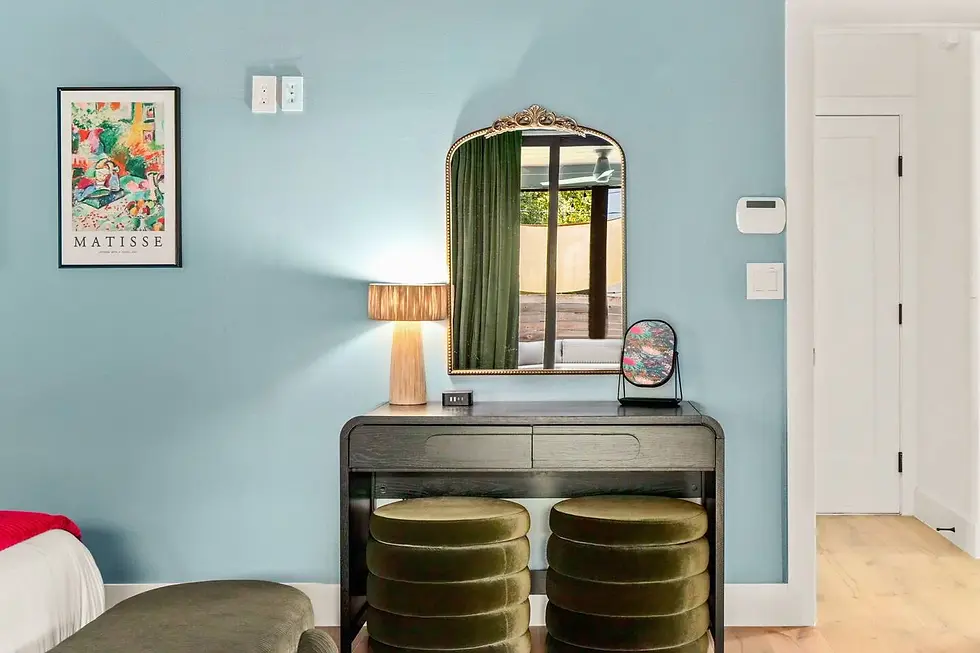
The best base for Austin landmarks is central East Austin, where you can reach downtown, the University of Texas, and the lakefront by rideshare, scooter, or bike. This recently renovated East Austin home is Cortado Villa, which was renovated in 2023 and sleeps up to 12 guests in 4 bedrooms and 3.5 bathrooms.
The location does real work for a landmark itinerary. Franklin Barbecue is 0.3 miles away and Arbor Food Park is 0.1 miles away. Rainey Street is 1.5 miles away, and the SXSW Convention Center is 1.1 miles away. Austin-Bergstrom International Airport is 8 miles away, about a 15-20 minute drive. The backyard has a shaded 7-person hot tub, a fire pit, and a 3-hole putt putt course, which helps after a day of stairs and sun. Dining seats 10 at the table plus 6 at the kitchen bar.
A few operational details are worth knowing before you book. Street parking is permit-restricted from 12PM to 8 PM, so use the free driveway. Every guest completes ID verification and a rental agreement within 48 hours of booking, and Cortado Villa is a registered short-term rental with the City of Austin, License OL 2024088078th. Booking direct saves up to 10% on fees and includes free late checkout until 12pm when there is no same-day arrival; check current pricing on the booking page.
Planning ahead pays off. AirROI puts the average Airbnb booking lead time in Austin at 41 days, and AirDNA counted 17,086 active Austin short-term rental listings in May 2026, down 10.9% year over year. For neighborhood comparisons, see our stay guide covering Austin neighborhoods, or browse large-group vacation home rentals in Austin.
If your trip includes the Hill Country, Moulin Rose in Dripping Springs sleeps up to 16 guests in 5 bedrooms and 4 bathrooms, about 30-35 minutes from downtown Austin. It sits 10-15 minutes from Hill Country wedding venues, wineries, and breweries. Our Dripping Springs day trip ideas cover the area.
What Should You Wear and Plan For at Austin Landmarks?
The right outfit for Austin landmarks is layered, breathable clothing and comfortable closed shoes, because you will walk on pavement and climb stairs. You will also stand outdoors at dusk. In October, daytime weather typically runs warm and evenings cool off, so check the forecast the night before.
Pack a hat and sunscreen for the Capitol lawn and Congress Avenue, where shade is limited. Bring a light jacket for the bat flight. For Mount Bonnell, shoes with grip matter more than style, since the route is 102 steps.
Plan around three constraints that most guides skip. Heat controls your schedule from late spring through early fall, so book outdoor stops for morning or evening. Parking near viewpoints and downtown is limited, so rideshare or scooters reduce stress. Tours, closures, and reservation rules also change, so verify with official sources the morning of your visit.
What Is the Best Way to See Austin Texas Landmarks in 2026?
The best way to see Austin Texas landmarks in 2026 is to match each stop to its time of day: the Capitol and Congress Avenue in the morning, Zilker and Barton Springs in the afternoon, and the bat bridge at dusk. Walk the downtown cluster, and use rideshare or scooters for Mount Bonnell and the LBJ Library.
The facts that shape the day are consistent: a 302-foot Capitol with daily tours, a mile-long Congress Avenue, a seasonal bat flight that is never guaranteed, and a heat-driven schedule. Choose two or three anchors rather than ten, and let the Hill Country, the food, and the lakefront fill the gaps.

If your itinerary leans on the downtown landmarks and the lakefront, the 7-person hot tub at Cortado Villa is a welcome end to a day of stairs and sun. Check availability here.
Frequently Asked Questions
Where should I stay in Austin, Texas to see the landmarks?
Cortado Stays offers Cortado Villa in central East Austin, a recently renovated home that sleeps up to 12 guests across 4 bedrooms and 3.5 bathrooms. It is 1 mile from the University of Texas campus and 0.3 miles from Franklin Barbecue. East Austin is a good base for downtown access by rideshare, scooter, or bike; view the full amenity list.
What should I wear in Austin, Texas in October?
Wear layers: breathable clothing for warm days, a light jacket for evenings, and comfortable closed shoes for walking and stairs. Add a hat and sunscreen for outdoor landmarks. Check the forecast before you go, since conditions vary from year to year.
What are Austin's most famous historic landmarks?
The best-known are the Texas State Capitol (1888), the Texas Governor's Mansion (1856), Congress Avenue, the Paramount Theatre (1915), the Driskill Hotel (1886), and the French Legation State Historic Site. Austin has 180 sites on the National Register of Historic Places.
Where can I book an Austin sightseeing tour?
Start with the Austin Visitor Center in the Littlefield Building or the official Visit Austin site for current operators and schedules. The Capitol runs its own expert-led and self-guided tours. For any paid tour, confirm the meeting point and cancellation terms, and ask what happens if the bats do not emerge.
What is the Texas State Capitol famous for?
The Texas State Capitol is famous for its Sunset Red Texas granite, quarried near Marble Falls, and its cast-iron dome topped by the Goddess of Liberty. At 302 feet, it is taller than the U.S. Capitol. Tours run seven days a week.
When do the Congress Avenue Bridge bats come out?
The Mexican free-tailed bats emerge at dusk from spring through fall. Exact timing follows sunset and weather, and a flight is never guaranteed on a given night. Arrive early and keep a backup plan.
How many days do you need to see Austin's landmarks?
Two days cover the main list comfortably. Spend one on the downtown corridor and the bat bridge, and one on Mount Bonnell, Zilker Park, Barton Springs Pool, and the LBJ Library. A single day works if you choose only two or three anchors.
Which Texas wine country stays are good for a romantic getaway near Austin?
Cortado Stays operates the Dripping Springs retreat Moulin Rose, 10-15 minutes from Hill Country wineries and breweries and about 30-35 minutes from downtown Austin. It sleeps up to 16, so it suits celebrations and group trips better than a couples-only weekend. If you are two people, a smaller property is the better fit.
Written by Alicia, Owner & Founder at Cortado Stays
Content powered by inkSTR.co


Comments