

Winter Weather in Austin TX: What Visitors Should Pack

Winter weather in Austin TX is mild and brief: December through February brings afternoon highs in the low to mid 60s, nights in the low to mid 40s, and mostly rain rather than snow. A hard freeze or ice event still arrives some years, so pack layers and leave a buffer day on either end of your trip.
Key Takeaways
Austin's winter highs average 62.5 to 66.5 degrees F and lows average 41.8 to 45.8 degrees F, with January the coldest month (Visit Austin, National Weather Service).
February is the driest winter month at 1.89 inches of normal rain, and measurable snow averages only a fraction of an inch (KXAN).
The National Weather Service reports about 12 sub-freezing days a year at Camp Mabry but about 33 at Austin-Bergstrom International Airport, so the station you read matters.
Impactful wintry precipitation, meaning ice, sleet, or snow that disrupts travel, hits the Austin area about once every two years.
Layers beat a heavy coat: pack a light jacket, a sweater, a rain shell, and one warm option for cold snaps.
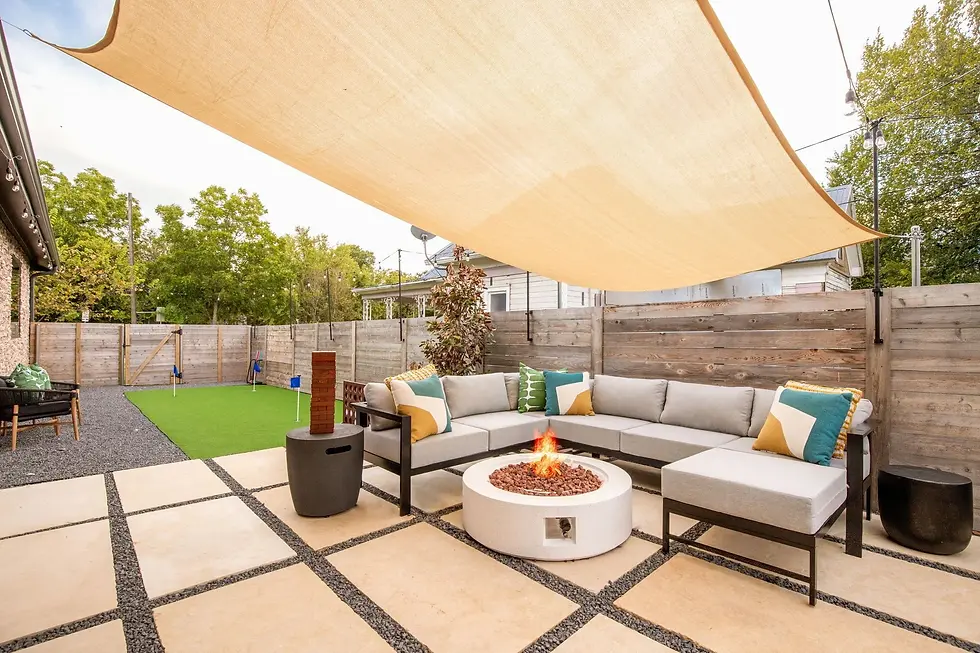
Cortado Villa in East Austin has a 7-person hot tub and a fire pit, and sits 0.3 miles from Franklin Barbecue.
Most winter weather guides stop at monthly averages. Averages are a fair starting point, but they hide the detail that changes a trip: an Austin afternoon can reach the mid 60s and the same night can fall below freezing.
At Cortado Stays, we host guests at Cortado Villa in East Austin through every season, and the winter questions repeat. Do I need a coat? Will it snow? Can we still use the hot tub? This guide answers them with data from the National Weather Service, Visit Austin, and KXAN, then shows where those numbers disagree and why.
In 2026 the practical advice is the same as in any recent year: trust the averages for packing and trust the live forecast for driving.
How Cold Does Winter Weather in Austin TX Get Month by Month?
Austin's winter runs December through February, with average highs between 62.5 and 66.5 degrees F and average lows between 41.8 and 45.8 degrees F, according to the Visit Austin weather page. The National Weather Service Austin/San Antonio office identifies January as the coldest month.
Month | Average High (F) | Average Low (F) | Rainy Days | Normal Rainfall (inches) |
December | 63.9 | 43.4 | 7.5 | 2.72 |
January | 62.5 | 41.8 | 7.6 | 2.64 |
February | 66.5 | 45.8 | 7.7 | 1.89 |
Temperatures and rainy days come from Visit Austin; rainfall comes from KXAN's monthly normals. The two sources use different methods, so small gaps between them are expected.
January's mean temperature sits near 52.1 degrees F, per the Climates to Travel guide. The coldest stretch of an average winter falls in early January, when average daily highs dip to about 61 degrees F and average lows to about 43.
February turns quickly. KXAN notes average highs climbing from 64 degrees F at the start of the month to 69 by the end, which is why a late-February trip feels closer to spring than to the January cold.
Rain adds a second variable. KXAN counts 7.25 inches of normal rainfall across the 89-day winter, with measurable precipitation on 22.8 of those days. The National Weather Service puts that total at roughly 20% of Austin's annual precipitation. Pack a rain shell, since about one winter day in four brings rain.

Does It Snow in Austin During the Winter?
Snow in Austin is rare and usually trivial. KXAN's climate averages show 0.2 inches of measurable snow in February, the only winter month with any average measurable snowfall. Ice, sleet, and freezing rain cause far more disruption than snow does.
Past events show how uncommon real accumulation is. The Climates to Travel guide records slight snow in Austin on Christmas 2004 and again in December 2017. In February 2021, snow depth reached 16 cm (6.4 inches), a level the guide describes as not seen for decades.
A 0.2 inch average blends many snowless Februaries with a few events, so no individual visit should plan around it. Treat snow as a bonus on the rare day it appears and ice as the real planning risk.

How Often Does Austin Get Freezing Temperatures?
A freeze means the temperature drops to 32 degrees F or below, and Austin sees them on a limited number of days each winter. The National Weather Service reports about 12 sub-freezing days a year at Camp Mabry and about 33 at Austin-Bergstrom International Airport, nearly three times as many.
That split is the detail most guides flatten into one citywide figure. Camp Mabry sits in central Austin, while the airport station sits at the southeast edge of the city. Your own count depends on where you sleep and which station your phone app reads.
KXAN says Austin typically gets two freezes in February. Temperatures here rarely fall far below 30 degrees F, so expect a mild afternoon followed by a night just below freezing, not a sustained deep freeze.
For visitors, that means the coat you need at 7pm differs from the one you need at 2pm. Residents carry the extra worry of covering tender plants and protecting exposed outdoor plumbing on the coldest nights.
What Counts as an Ice Event, and How Do You Check Road Conditions?
An impactful wintry event in Central Texas means freezing rain, sleet, or snow heavy enough to cause major travel problems. The National Weather Service says that happens about once every two years in the Austin area, even though the seasonal averages stay mild.
The disruption comes from mismatch. A thin glaze of ice on a road network that rarely sees it can stall commutes and delay flights at Austin-Bergstrom, even when the whole event lasts under a day. Mild averages tell you the odds, not the consequences.
Current road conditions in Austin change by the hour, so rely on live sources rather than any article. Check the official city and state transportation road-condition pages and a local forecast such as the KXAN weather blog before you drive. The tips below are our own experience hosting guests through cold snaps, not official guidance.
Look at the forecast 48 to 72 hours before arrival, and again the morning you leave.
Delay driving until temperatures climb above freezing if rain is expected overnight.
Stock groceries on day one so a closed road does not become a hungry group.
Choose a home with driveway parking so you are not chipping ice off a street-parked car.
Follow hot tub rules in cold weather: shower first, enter and exit slowly, and limit soaks to 15 minutes.
Why Do Austin Weather Sources Give Different Numbers?
Austin weather sources differ because each one uses a different observation station, averaging period, and rounding method. Time and Date, for example, draws on Camp Mabry data from 1992 to 2021 and lists a January average of 63 degrees F high, 42 degrees F low, and 2.40 inches of precipitation.
Compare that with Visit Austin's 62.5 and 41.8 degrees F, and KXAN's 2.64 inches of January rain. None of the three is wrong. They are measuring slightly different things over slightly different decades.
The same logic explains why you may see conflicting claims about the snowiest month or the exact winter rainfall total. When two pages disagree, check which station and date range each one cites. Then compare numbers only within a single source.
For planning, the differences are small: a degree or two on temperature and a few tenths of an inch on rain. The gap that deserves attention is the freeze count between stations, covered above.
How Do Climate Normals Compare With a Single Winter's Forecast?
Climate normals are multi-decade averages, while a forecast describes one specific stretch of days. Every figure in this guide is a normal. It tells you what winter weather in Austin TX usually looks like, not what the winter you are booking will do.
Seasonal outlooks, such as the NOAA winter forecast KXAN explains each year, tilt the odds toward warmer, cooler, wetter, or drier. They do not predict a specific ice day. As of 2026, treat an outlook as context and a 3 to 7 day forecast as the decision tool.
A practical split works well. Use normals to decide what goes in the suitcase and which month to visit. Use the live forecast to decide whether Tuesday is a barbecue day or a stay-in day.
Does Austin Have Good Weather Year Round?
Austin has a humid subtropical climate, which the National Weather Service describes as having relatively mild winters with generally low precipitation. Yearly temperatures typically range from the low 40s to the high 90s degrees F, so winter is the cool end of a long warm calendar.
Compared with Austin's summer heat, winter is the easiest season for outdoor plans. A walk to Franklin Barbecue or a patio lunch is comfortable at midday in a way that July never is. The trade-off is gray, damp days and the occasional cold front that makes a fire pit feel essential.
If you are weighing seasons, our guide to where to stay in Austin covers how neighborhoods feel across the year. Winter is a strong pick if you want walkable days without the heat.
What Should You Pack for an Austin Winter?
An Austin winter packing list is built around layers, because a 40-something morning and a mid-60s afternoon can fall on the same day. Plan for a light jacket, a sweater, a rain shell, and one warmer layer you can add if a cold front arrives.
Base layers: short sleeves and long sleeves, since afternoons often reach the 60s.
Outer layer: a light insulated jacket or fleece, plus a packable rain shell for the rainy days.
Cold-snap insurance: a hat, gloves, and a warmer sweater for freezing nights.
Shoes: closed-toe walking shoes; Franklin Barbecue's line and East Austin sidewalks both reward them.
Swimwear: a suit for a hot tub soak; nobody regrets bringing one.
The same layering logic works in the fall. For October, we haven't pulled verified monthly data here, so treat this as general guidance: expect warmer days than winter, pack lighter layers, and keep a thin jacket for evenings. Check the forecast the week before you leave.
What Are the Best Things to Do in Austin During Winter?
The best winter activities in Austin suit a 60-degree afternoon: barbecue lunches, food-park hopping, a campus walk, and a hot tub soak after dark. For indoor backup on cold or wet days, concerts and sports are your best option.
From this East Austin home, most of these are a short walk. Franklin Barbecue is 0.3 miles away. Go before the line forms on a cold morning and bring a layer; standing outside in January is a different experience from standing outside in July. Check the restaurant's site for current hours, ordering details, and prices, since we haven't verified them here.
Arbor Food Park is 0.1 miles away and works best on a sunny afternoon, since it is an outdoor setup. Paperboy, a breakfast stop, is 0.5 miles away. The University of Texas campus is 1 mile out and pleasant on foot on a crisp day.
For evenings, Moody Center is 0.8 miles from the house and keeps concerts and basketball indoors. Ticket prices vary by event, so check the venue site. Rainey Street is 1.5 miles away; its converted-bungalow bars are livelier in cooler weather, though you will want a jacket on the patios after dark. For more ideas, see our guide to things to do in Austin.
If your group prefers wine country, Moulin Rose in Dripping Springs sits 14 minutes from Jester King Brewery and 5 minutes from Deep Eddy Vodka. The cooler months suit tasting-room visits better than August does. Browse things to do in Dripping Springs before you go.
Where Should You Stay for an Austin Winter Trip?
The best winter stay in Austin is a home with outdoor heat sources, a real kitchen, and walkable food, so cold evenings feel like part of the trip. Cortado Villa in East Austin and Moulin Rose in Dripping Springs both fit, each in a different way.
Cortado Villa sleeps up to 12 across 4 bedrooms and 3.5 bathrooms, and was renovated in 2023. The backyard has a 7-person hot tub preset to 102 degrees F, a propane fire pit with a large sectional, a BBQ grill, and a 3-hole putt-putt course. It does not have a pool, which matters little in January.
Inside, the kitchen has a Keurig, a Hario V60, and a Fellow gooseneck kettle for slow mornings. The living room has a 75-inch 4K TV, a Sonos soundbar, and a record player. A full desk with Google Fiber covers anyone working from the house, and the airport is 8 miles away, about a 15 to 20 minute drive. See the full amenity list for details.
Moulin Rose sleeps up to 16 across 5 bedrooms and 4 bathrooms, with air conditioning and heating throughout. Its game room has a pool table, arcade, foosball, and a 100-inch smart projector, which makes it the better pick for a big group on a gray day. The pool cannot be heated, so winter here centers on the hot tub, fire pit, and indoor games. Downtown Austin is about 30 to 35 minutes away, so plan on a car or rideshare.
Booking direct through cortadostays.com saves up to 10% on fees, and you get free late checkout until 12pm when there is no same-day arrival. Early check-in or late checkout can be arranged for a $150 fee. Check current pricing on the booking page, since rates change.
On trust: every guest completes ID verification and a rental agreement within 48 hours of booking, and Cortado Villa is a registered short-term rental with the City of Austin, license OL 2024088078th. Our frequently asked questions page covers check-in. For comparisons across neighborhoods, see our vacation home rentals in Austin guide.
Frequently Asked Questions
How is winter in Austin, Texas?
Winter in Austin is mild, with average highs of 62.5 to 66.5 degrees F and lows of 41.8 to 45.8 degrees F from December through February. Rain falls on roughly 7 to 8 days a month, and snow is rare. Occasional cold fronts bring freezing nights, so layers matter more than a heavy coat.
What is the coldest month in Austin, Texas?
January is the coldest month, according to the National Weather Service. Normal highs are in the low 60s and normal lows in the low 40s. The coldest average days fall in the first week of January.
Does it snow in Austin during the winter?
Snow is uncommon. KXAN's averages show measurable snow only in February, and only a fraction of an inch. Notable exceptions include slight snow on Christmas 2004 and in December 2017, and a 6.4 inch snow depth in February 2021.
How often does Austin get freezing winter weather?
Freezing nights happen several times a winter, but not continuously. The National Weather Service counts far more sub-freezing days at the airport station than at Camp Mabry in central Austin. KXAN says Austin typically gets two freezes in February.
What should I pack for a winter trip or cabin-style stay near Austin?
Pack layers: a light jacket, sweater, rain shell, closed-toe shoes, and a hat and gloves for cold snaps. Add a swimsuit if your rental has a hot tub, as Cortado Villa and Moulin Rose both do. Bring slippers or warm socks for tile and wood floors on cool mornings.
What should I wear in Austin in October?
October is typically warmer than winter, so lighter clothing works for most of the day. Add a thin jacket or sweater for evenings and a rain layer if the forecast calls for it. Check the forecast a week before you travel.
Where should you stay in Austin for a winter trip?
Cortado Stays offers two design-forward homes: Cortado Villa in East Austin, sleeping up to 12 with a 7-person hot tub and fire pit, and Moulin Rose in Dripping Springs, sleeping up to 16 with a game room and Hill Country views. Choose Cortado Villa for walkable barbecue and nightlife, and Moulin Rose for wineries and breweries. Whichever you pick, look for driveway parking and outdoor heat sources.
What Should You Remember About Winter Weather in Austin TX?
Winter weather in Austin TX means highs in the low to mid 60s, lows in the 40s, a driest month in February, and snow so rare that ice is the bigger risk. The National Weather Service counts impactful wintry events about once every two years.
Pack layers, read the live forecast before driving, and compare weather numbers only within a single source. Use the averages to plan the trip and the forecast to plan the day.
Looking ahead to winter 2026 and beyond, the same approach holds: mild days to enjoy, a few cold snaps to prepare for, and a warm home base to come back to.

If you are planning a cool-weather trip, Cortado Villa gives you a 7-person hot tub set to 102 degrees F, a good answer to a 42 degree January night. Check availability here.
Written by Alicia, Owner & Founder at Cortado Stays
Content powered by inkSTR.co


Comments